Operating a generator in the UAE requires more than choosing a machine with a soundproof enclosure. Contractors, event organisers, facility managers, and industrial operators must consider noise at nearby properties, local authority requirements, safe fuel storage, fire prevention, and the operating hours of the site.
These considerations become particularly important for night-time construction, residential developments, luxury hotels,HVAC outdoor events, commercial buildings, and temporary power installations. A generator that appears quiet beside the machine may still disturb neighbouring properties, especially when sound travels across open ground or reflects from nearby buildings.
This guide explains how to approach soundproof generator compliance in the UAE, how acoustic canopies reduce noise, what to verify with Dubai and Abu Dhabi authorities, and how to plan a safe temporary power installation using recognised technical guidance and official reference sources.
Important regulatory distinction: Noise limits such as 65 dBA at a site boundary, 55 dBA during the day, and 45 dBA at night should not be treated as universal UAE limits without checking the applicable authority, land-use category, measurement location, time period, and permit conditions. The exact requirements can vary by jurisdiction and project.
Understanding UAE generator noise limits and compliance
The first step in soundproof generator compliance in the UAE is identifying which environmental and construction rules apply to the installation. A generator at an industrial facility may be assessed differently from one beside a residential building, a hotel, or a noise-sensitive location.
Dubai Municipality generator noise permit: what should operators check?
The term Dubai Municipality generator noise permit is often used when searching for the approvals required to operate temporary generators. However, it is important to distinguish a standalone noise approval from a construction or night-work permit that includes noise-control conditions.
Dubai Municipality provides a for work during specified hours and subject to application conditions. The Dubai Development Authority also provides a. Its Circular 613, dated 27 February 2025, reminds relevant project parties of construction-hour and noise restrictions.
Before installing a generator, contractors should establish:
Whether the project requires a construction, night-work, environmental, or other site-specific approval.
Which authority governs the plot, such as Dubai Municipality, Dubai Development Authority, or Trakhees/PCFC.
Whether the generator is covered by the project's approved environmental management and noise-control plans.
Whether restrictions apply to the generator itself, the construction activity it powers, or both.
Where noise must be measured and which measurement method and operating period apply.
A night-work permit should not be assumed to exempt a generator from applicable noise restrictions. Confirm the conditions of the actual approval before arranging after-hours power.
Are 65 dBA by day and 55 dBA at night universal limits?
No. Published requirements differ by area, authority, activity, and measurement point.
For example, Dubai Development Authority's 2025 circular refers to residential-area construction noise limits of 45–60 dBA during permitted working hours. Separately, Dubai Municipality's technical guidance for entertainment areas states that noise measured outside the premises boundary should not exceed 55 dBA from 7:00 a.m. to 8:00 p.m. and 45 dBA from 8:00 p.m. to 7:00 a.m. under the referenced provision. These are different regulatory contexts and should not be merged into a single generator standard.
The following table helps explain the figures often mentioned in project briefs.
Noise figure | How to interpret it |
|---|---|
65 dBA | May be a project target, an industrial-area criterion, or a generator's published sound-pressure rating. It is not a universal UAE boundary limit. |
55 dBA during the day | Appears in specific Dubai noise-control guidance, including the cited entertainment-area provision. Applicability must be confirmed. |
45 dBA at night | Also appears in the cited Dubai entertainment-area guidance and other noise-control references. It should not be applied automatically to every site. |
45–60 dBA for construction | The range cited in DDA's 2025 circular for residential areas during permitted construction hours; the applicable limit depends on the project context. |
The key point is that a generator rated at 65 dBA does not automatically comply with a site requiring 45 dBA at its boundary. The generator's rating and the legal or contractual limit may refer to different locations and conditions.
For industrial and port-related sites, the includes different allowable noise ranges for residential, commercial, and industrial areas. Always consult the revision applicable to the site.
EAD Abu Dhabi noise requirements
For projects involving EAD Abu Dhabi noise requirements, the responsible project team should confirm:
Whether an EAD environmental licence or another environmental approval is required.
The applicable noise limits for the site's land-use category.
Whether baseline or operational noise monitoring is required.
Whether night-time operation requires additional mitigation or approval.
Whether the approved environmental management plan sets project-specific limits.
Do not assume that a 55 dBA daytime or 45 dBA night-time threshold automatically applies to every Abu Dhabi generator installation. Confirm the current requirements and any project-specific conditions with the responsible authority.
How soundproof generator canopies reduce noise
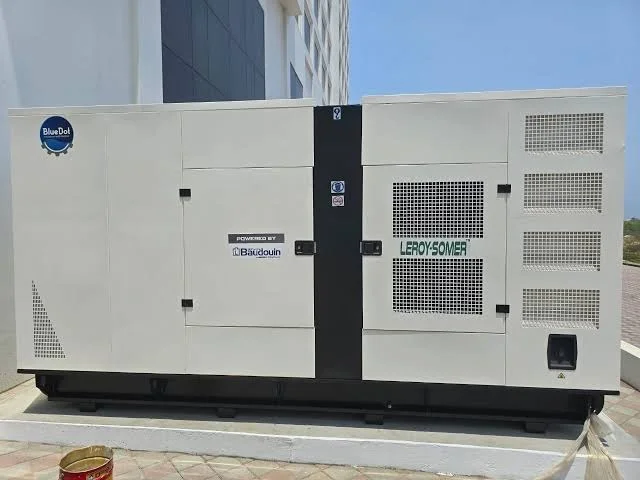
A soundproof generator, also called a silent or acoustic-canopy generator, encloses the engine and alternator inside a specially designed housing. The enclosure reduces noise escaping from the engine, exhaust system, cooling fan, and vibrating metal surfaces.
The amount of noise reduction depends on the generator's power rating, canopy design, exhaust silencer, ventilation arrangement, operating load, and installation conditions.
How can a canopy reduce generator noise from 90 dBA to 65 dBA?
A reduction from 90 dBA to 65 dBA represents a 25 dB decrease. This is a substantial reduction, but it must be supported by the actual generator's test data rather than assumed for every soundproof enclosure.
Manufacturer information illustrates the range of possible performance. Maximus Engineering, for example, reports approximately 65–75 dB at a distance of seven metres, depending on generator rating. Other manufacturers publish different values depending on their equipment and acoustic design.
The principal noise-control components are:
Sound-absorbing materials fitted inside the enclosure reduce sound energy reflected within the canopy. The lining must be suitable for the generator's operating temperature and environment.
Exhaust silencers reduce engine-exhaust noise. A more heavily attenuated silencer may be necessary for sites close to homes, hotels, or other noise-sensitive properties.
Specially designed air passages allow the engine and radiator to receive sufficient cooling air while reducing the direct escape of sound through the ventilation openings.
Suitable mounts help reduce vibration transmitted from the generator into its supporting base and nearby structures.
These components work together. A thick enclosure alone is not enough if sound escapes through open ventilation paths, poorly sealed doors, or an unsuitable exhaust system.
Why the seven-metre sound rating matters
Generator suppliers commonly publish sound-pressure levels in dB(A) at a specified distance, often seven metres. This allows buyers to compare models, provided the measurement conditions are comparable.
The explains how distance, reflective surfaces, and the measurement location affect reported noise levels.
For a fair comparison, request the following information from the supplier:
Sound-pressure level in dB(A).
Measurement distance and measurement method.
Generator model and rated power.
Operating load during the test.
Acoustic canopy and exhaust-silencer specification.
Any available factory test report.
A rating of 65 dBA at seven metres does not mean the generator will produce 65 dBA at a neighbouring building or site boundary. That measurement must be verified at the relevant location under the conditions required by the project.
Can a low-noise generator meet a 45 dBA night-time target?
It may be possible, but selecting a generator advertised as silent is not sufficient by itself.
For example, an acoustic canopy rated at 65 dBA at seven metres would not automatically satisfy a 45 dBA boundary target at that same distance. The project may need greater separation, a more effective acoustic enclosure, additional noise barriers, revised positioning, or a different power arrangement.
The final design should be based on a noise assessment that accounts for the surrounding buildings, background noise, generator operating conditions, and the required measurement point.
Choosing low noise canopy generator hire in the UAE
For construction companies and event organisers, hiring a low-noise generator can be a practical alternative to purchasing specialist equipment. However, the rental specification should identify the required acoustic performance rather than relying on labels such as silent, super silent, or soundproof.
When arranging consider the following factors.
Selection factor | What to confirm |
|---|---|
Power capacity | The generator can support the required electrical load without overloading. |
Acoustic performance | The supplier provides a documented dB(A) rating and measurement distance. |
Site sensitivity | The proposed unit is suitable for nearby residences, hotel rooms, offices, or other sensitive locations. |
Exhaust direction | Exhaust noise is controlled and the outlet is positioned appropriately. |
Ventilation | The canopy maintains sufficient cooling airflow under UAE operating conditions. |
Operating hours | The generator and related work comply with site approvals and time restrictions. |
Maintenance | Doors, acoustic seals, silencers, and vibration mounts are kept in suitable condition. |
A generator must also deliver the required power reliably. An undersized unit can overload, while an unsuitable enclosure may restrict cooling or make maintenance difficult. The correct rental choice balances electrical capacity, acoustic performance, fuel arrangements, and site safety.
Fuel storage and Civil Defence fire-safety considerations
Noise control is only one part of soundproof generator compliance in the UAE. Diesel storage, refuelling, spill containment, exhaust clearance, and access for emergency response must also be considered.
Is 120% double-wall bunded fuel containment mandatory?
The requirement for a 120% bunded fuel spill tray should be checked against the applicable fire-safety code, tank design, environmental approval, and project specifications. I could not verify a universal UAE Civil Defence rule requiring 120% containment for every temporary generator.
As a useful regulatory comparison, the have been referenced in specialist guidance for a minimum secondary-containment capacity of 110% of the largest tank in their applicable scope. That does not establish a universal requirement for all temporary generator installations.
Where the project specification calls for 120% containment, the supplier and site safety team should confirm that the proposed system meets that requirement.
A double-wall tank and a separate bund are also different arrangements. A double-wall tank has an outer protective wall around the inner fuel tank. A bund or spill tray provides secondary containment around a tank or equipment that could leak.
Fuel safety measures for temporary generator installations
A practical site inspection should consider the following controls:
Secondary containment: Confirm the required capacity and ensure the containment system is compatible with diesel fuel.
Tank condition: Check for leaks, corrosion, damaged fittings, and defective hoses.
Safe positioning: Locate fuel storage away from ignition sources, vehicle impact hazards, and unsuitable drainage areas.
Refuelling procedures: Use approved procedures and equipment, with suitable spill-response arrangements.
Fire protection: Follow the applicable fire-safety design, separation, access, and emergency-response requirements.
Inspection records: Keep the relevant equipment documentation, inspection records, and approvals available for review.
The exact requirements depend on the installation and the applicable authority. The responsible engineer should verify the current UAE Fire and Life Safety Code requirements and any instructions from the relevant Civil Defence authority rather than assuming a single containment percentage applies everywhere.
Best practices for night-time construction projects
Night-time generator operation requires careful planning because construction activity and mechanical equipment may be subject to different restrictions. A generator that is electrically suitable for a project may still be inappropriate if it causes excessive noise at neighbouring properties.
For night-time construction, the project team should:
Confirm the approved working hours and any night-work permission.
Select a generator using a documented acoustic rating appropriate for the site.
Position the equipment as far as reasonably practicable from sensitive receptors, subject to ventilation and safety clearances.
Direct exhaust and ventilation outlets away from nearby occupied buildings where the design permits.
Use suitable vibration isolation and inspect acoustic seals and silencers.
Arrange noise measurements at the locations specified in the project plan.
Maintain a record of complaints, corrective measures, inspections, and monitoring results.
Where a project has a strict night-time noise target, a competent acoustic specialist can help determine whether the proposed generator, barriers, and separation distances are adequate.
Soundproof generator planning for luxury residential events
Luxury residential events, private celebrations, outdoor receptions, and hotel functions have a different set of practical requirements. Guests may be close to the generator, and nearby residents may be particularly sensitive to persistent engine or exhaust noise.
A suitable temporary power arrangement should address both noise and the operational needs of the event.
1. Select a generator with a verified acoustic rating
Ask for the sound-pressure level at a stated distance, together with the applicable test conditions. If the event is near bedrooms, residential balconies, or hotel guest rooms, a standard acoustic canopy may not provide sufficient attenuation.
2. Position the generator carefully
Place the generator in an approved service area away from guests and neighbouring properties where practicable. Avoid locations where surrounding walls could reflect noise towards occupied areas.
The location must still provide adequate ventilation, safe exhaust discharge, maintenance access, and compliance with fire-safety clearances.
3. Coordinate power and acoustic requirements
The electrical load calculation should include the event's lighting, audio equipment, catering equipment, temporary cooling, and other electrical systems. If the installation requires several generators, the combined sound level must be considered: two equally loud sound sources operating together can increase the overall sound level by approximately 3 dB.
For events using temporary air conditioning, power capacity and cooling demand should be assessed together rather than selecting a generator based on the air-conditioning rating alone.
4. Monitor noise during the event
Where required by the approval or event plan, measure noise at the designated boundary or receptor location. If the readings exceed the applicable limit, the team should follow its approved corrective-action procedure.
5. Plan fuel and emergency access
Keep the generator and fuel system in a controlled service area, maintain appropriate spill containment, and preserve access for authorised personnel and emergency responders.
How to verify soundproof generator compliance before delivery
A short pre-delivery review can help prevent delays, complaints, and expensive equipment changes after the generator reaches the site.
Generator compliance checklist
0 of 7 items reviewed
For complex construction projects, the review should involve the site manager, HSE team, electrical engineer, and the person responsible for environmental compliance. For events, the organiser should also coordinate with the venue and the relevant permitting authority.
Frequently asked questions
What is soundproof generator compliance in the UAE?
It is the process of selecting, installing, and operating a generator in accordance with applicable noise limits, project approvals, environmental conditions, and fire-safety requirements. The specific requirements depend on the emirate, site location, activity, and operating hours.
What are the Dubai Municipality generator noise limits?
There is no single limit that can safely be applied to every generator installation. Dubai Municipality guidance for entertainment areas includes 55 dBA during the day and 45 dBA at night at the premises boundary under the cited provision. Other projects may be governed by different limits or approval conditions.
Does a soundproof generator rated at 65 dBA comply with a 45 dBA limit?
Not automatically. A 65 dBA rating at seven metres is a measurement under specified conditions. Compliance with a 45 dBA boundary target requires assessing the noise at the relevant boundary and determining whether additional mitigation is needed.
Is a special permit required for a generator running at night in Dubai?
The requirement depends on the project and the work being undertaken. Construction projects may need night-work approval, and the approval does not automatically remove applicable noise restrictions. Confirm the requirements with the responsible authority before starting work.
What are the EAD Abu Dhabi noise requirements?
EAD's 2024 air-quality system decree addresses permissible noise levels and environmental licensing. The specific requirements applicable to a generator should be confirmed through the current regulations, technical guidance, and project approvals.
How much noise can an acoustic canopy reduce?
Performance depends on the generator and its enclosure. Published manufacturer specifications include ratings around 65–75 dB(A) at seven metres for some models. A reduction from 90 to 65 dBA is possible only where the equipment's measured performance supports that result; it should not be assumed for every generator.
Is 120% fuel bunding required for every generator in the UAE?
I could not verify that as a universal requirement. Containment capacity depends on the applicable regulations, tank design, authority requirements, and project specification. Where a project expressly requires 120%, obtain confirmation that the selected tank or bund arrangement satisfies it.
What type of generator is suitable for a luxury residential event?
Choose a generator with a documented low-noise rating, sufficient electrical capacity, suitable ventilation, and an appropriate exhaust silencer. Position it carefully and verify the noise level at the required measurement location. The correct selection depends on the event's load, location, and approval conditions.
Conclusion:
Soundproof generator compliance in the UAE requires a combination of suitable equipment, correct placement, documented acoustic performance, approved working arrangements, and safe fuel management.
The key is to distinguish the generator's published noise rating from the limit that applies at the actual site boundary. Figures such as 65 dBA, 55 dBA, and 45 dBA must be interpreted within the relevant authority's rules and the project's conditions, not treated as universal limits.
For construction sites, industrial facilities, hotels, and residential events, early planning can reduce noise complaints, avoid equipment changes, and support safer, more reliable temporary power.
If you need help assessing the power and acoustic requirements of your project, to discuss the generator rating, site conditions, operating hours, and applicable compliance requirements.