Choosing the Right Portacabin in UAE Size Design Quality
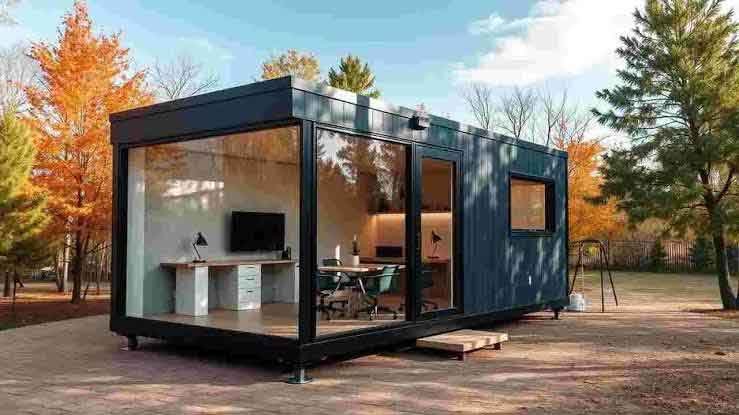
For businesses operating in the UAE, additional space may be needed for a construction-site office, security room, staff facility, meeting room, storage area, or temporary workplace. A portacabin can provide that space without the same construction timeline associated with a conventional building.
However, choosing the right portacabin in UAE requires more than comparing prices. Size, design, construction quality, insulation, electrical systems, fire safety, site conditions, and intended use all influence whether a unit will actually meet a business’s requirements.
Dubai Municipality’s Dubai Building Code establishes minimum requirements relating to health, safety, welfare, building design, environmental impact, and sustainable development. Abu Dhabi’s current Code of Practice for Temporary Structures also specifically addresses portable buildings, including their positioning, fire safety, electrical installations, access, and lifting.
This makes it important to evaluate a portacabin as a complete building solution rather than simply as a prefabricated unit.
Start With the Purpose of the Portacabin
The first step is to identify exactly how the cabin will be used.
A portacabin intended as a small security office will have different requirements from one used by several employees every day. Similarly, a temporary construction office may need workstations and meeting space, while staff accommodation may require bedrooms, sanitary facilities, ventilation, and other provisions.
Common applications include:
Construction-site offices
Security cabins
Sales offices
Meeting rooms
Staff welfare facilities
Site accommodation
Storage rooms
Classrooms and training rooms
Temporary commercial offices
Reception facilities
Defining the purpose first helps determine the appropriate size, layout, materials, electrical capacity, air conditioning, doors, windows, and safety provisions.
1. Choosing the Right Portacabin Size
Size is one of the first decisions a business needs to make, but the correct size is not necessarily the largest available option.
Instead, consider how the space will be used.
Consider the Number of Occupants
Estimate how many people will regularly use the cabin. An office for two employees will have different space requirements from an office accommodating ten or twenty people.
Also consider whether employees will need:
Individual desks
Shared workstations
Meeting tables
Filing cabinets
Printers
Equipment
Storage
Reception space
Planning furniture before selecting the cabin can prevent a situation where the finished space feels overcrowded.
Think About Future Requirements
If the business expects its workforce or project team to grow, selecting a slightly more flexible layout may be worthwhile.
For example, instead of choosing a cabin that only accommodates the current number of employees, a business could consider whether an additional workstation or partitioned area might be required later.
For larger projects, several portable buildings can also be arranged as a larger facility. Abu Dhabi’s temporary-structures guidance specifically addresses situations involving multiple portable buildings and requires appropriate access, walkways, emergency planning, and fire-safety arrangements.
Don’t Ignore External Space
The cabin’s internal dimensions are only part of the calculation.
The site also needs sufficient space for:
Delivery
Installation
Access
Steps and entrances
Emergency exits
Walkways
Utility connections
Maintenance
Possible future removal
A cabin that fits inside the available plot on paper may still be unsuitable if there is insufficient room for safe access or installation.
2. Select a Practical Internal Layout
A good portacabin design should make the available floor area useful.
For an office, an open-plan arrangement may work well where employees need shared workspace. A partitioned layout may be more appropriate when separate offices or meeting rooms are required.
Before ordering, consider:
Work areas: Where will desks and equipment be positioned?
Meeting space: Is a dedicated meeting room required?
Storage: Will files, tools, or materials need dedicated storage?
Circulation: Can people move comfortably between rooms?
Doors: Are entrances positioned conveniently?
Windows: Do they provide useful daylight and visibility without creating unnecessary heat gain?
Services: Where will air conditioning, electrical outlets, lighting, plumbing, and other services be located?
A well-planned layout can make a relatively compact cabin considerably more functional.
3. Consider the UAE Climate
The UAE’s climate makes thermal performance particularly important when selecting a portable building.
Dubai Municipality’s building framework includes thermal-insulation requirements and provides tools for calculating insulation and other building-performance requirements.
Businesses should therefore ask suppliers about the insulation used in:
External walls
Roof
Floor
Doors
Windows
Dubai’s technical regulations for thermal insulation specify characteristics including durability, resistance to moisture and environmental conditions, insulation efficiency, and fire-related properties for insulation materials used in external walls and roofs.
For a business, this matters because the cabin’s thermal envelope affects indoor comfort and the workload placed on its air-conditioning system.
A cabin with inadequate insulation may require more cooling to maintain a comfortable indoor environment.
4. Check the Quality of Construction
Two portacabins can have similar dimensions but very different levels of construction quality.
When comparing units, look beyond the external appearance.
Ask about:
Structural frame
Wall panels
Roof construction
Floor system
Insulation
Doors and windows
Corrosion protection
Interior finishes
Waterproofing
Electrical installation
The supplier should be able to provide technical specifications rather than simply describing the unit as “high quality.”
Dubai Municipality’s current building system framework notes that innovative building systems can be assessed against minimum safety and quality standards as well as suitability for the local environment.
That reinforces an important principle: quality should be supported by specifications and documentation, not just marketing terminology.
5. Pay Attention to Insulation Quality
Insulation deserves separate attention because of its role in the UAE’s hot climate.
Ask the supplier:
What insulation material is being used?
What is its thickness?
Is insulation provided in the roof as well as the walls?
How are joints sealed?What type of glazing is installed?
Is the insulation suitable for the intended application?
Dubai’s published thermal-insulation regulations state that insulation materials used in external walls and roofs should have properties including high insulation efficiency, resistance to water and humidity, durability, and resistance to prevailing environmental conditions.
Businesses should also remember that insulation is only one part of thermal performance. Windows, doors, roof exposure, air leakage, and air-conditioning design all contribute to the indoor environment.
6. Choose the Right Air-Conditioning Arrangement
In the UAE, air conditioning is normally an essential consideration for an occupied portacabin.
The required system depends on:
Cabin size
Number of occupants
Internal equipment
Window area
Insulation
Orientation
Expected operating hours
Location
Intended indoor temperature
Avoid selecting an air-conditioning system solely on the cabin’s floor area. A proper assessment should consider the actual cooling load.
Dubai Municipality’s building-code resources include AC-unit schedules alongside insulation and glazing calculations, reflecting the connection between building design and mechanical cooling requirements.
7. Examine Electrical Quality and Capacity
A modern office cabin may contain computers, printers, lighting, air conditioners, refrigerators, water heaters, communication equipment, and other electrical loads.
Before choosing a unit, determine the expected electrical demand.
Ask about:
Distribution board
Number of sockets
Lighting
Air-conditioning connections
Cable specifications
Earthing
Protection devices
Generator or external power connection requirements
For portable buildings in Abu Dhabi, the current temporary-structures code requires electrical installations to be carried out by a competent electrician and calls for periodic testing of distribution boards, cables, sockets, and other fixed electrical installations.
This demonstrates why electrical quality should be treated as a safety and operational consideration rather than an afterthought.
8. Consider Fire Safety From the Beginning
Fire safety requirements should be considered during the selection and layout stage.
Depending on the application and location, a portable building may require appropriate:
Fire detection
Firefighting equipment
Emergency exits
Emergency lighting
Exit signage
Safe access and egress
Fire-safe materials
Separation between buildings
Abu Dhabi’s current guidance requires portable buildings to be fit for purpose and compliant with applicable fire and electrical safety regulations. It also addresses fire detection and firefighting equipment, spacing between portable buildings, access, and emergency exits.
The exact requirements can vary according to the emirate, site, building use, and applicable regulations, so businesses should confirm requirements with the relevant authority.
9. Look Carefully at Doors and Windows
Doors and windows affect more than appearance.
For an office cabin, windows can improve natural lighting and visibility. For a security cabin, visibility may be an essential functional requirement.
At the same time, openings can contribute to heat gain if they are not appropriately designed.
Check:
Window type
Glazing
Frame quality
Door construction
Locking system
Sealing
Emergency exit arrangements
Shading where required
The goal is to balance natural light, ventilation, security, thermal performance, and safe access.
10. Check the Floor and Roof Construction
The floor and roof are sometimes overlooked when buyers focus on walls and appearance.
Ask about the floor’s construction and expected loading, particularly if the cabin will contain heavy equipment, storage racks, machinery, or concentrated loads.
The roof should also be assessed for:
Waterproofing
Insulation
Drainage
Corrosion protection
Maintenance access
Suitability for the local climate
A quality inspection should cover the entire building envelope, not just visible interior finishes.
11. Evaluate the Site Before Delivery
A good portacabin can still become a poor installation if the site has not been properly prepared.
Abu Dhabi’s portable-building guidance requires a level concrete base and addresses safe positioning, access and egress. It also requires consideration of spacing between portable buildings.
Before delivery, check:
Ground condition
Base requirements
Drainage
Delivery access
Vehicle access
Lifting area
Overhead obstructions
Utility connection points
Emergency access
Space around the cabin
If a crane is required, lifting arrangements should be planned in advance. Abu Dhabi’s guidance requires manufacturer recommendations to be followed and states that portable buildings should not be lifted unless their lifting points have been appropriately inspected and certified.
12. Check New and Used Portacabins Differently
If you are considering a used portacabin, inspect its condition carefully rather than comparing it with a new cabin on price alone.
Look for:
Corrosion
Water damage
Roof leaks
Damaged panels
Floor deterioration
Door problems
Window damage
Electrical modifications
Air-conditioning condition
Previous repairs
Ask for maintenance and modification records where available.
A used cabin can be practical when it is structurally sound and suitable for the intended application, but significant repairs can change the overall cost advantage.
13. Verify Compliance Before Buying or Renting
Compliance should be checked before committing to a unit.
Dubai Municipality states that its building-permit procedures are intended to support approved specifications and quality standards and include technical inspections for applicable projects.
Businesses should therefore determine:
Which authority has jurisdiction over the site
Whether a permit or approval is required
Whether the intended use is permitted
What fire-safety requirements apply
What electrical requirements apply
Whether specific structural standards apply
Whether additional requirements apply to accommodation or workplaces
Do not assume that because a cabin is “temporary,” every regulatory requirement automatically disappears.
14. Compare Suppliers on Total Value
The lowest quotation is not necessarily the best deal.
When comparing suppliers, look at the complete package.
Compare:
Cabin specification
What materials and systems are included?
Insulation
What material and thickness are provided?
HVAC
Is air conditioning included, and is the capacity appropriate?
Electrical system
What distribution equipment, lighting, and sockets are included?
Installation
Does the price include delivery, lifting, positioning, and connections?
Safety
What fire-safety equipment and provisions are included?
Warranty
What does the warranty cover and for how long?
After-sales support
Is maintenance available after installation?
Modifications
Can the cabin be adapted if requirements change?
Removal or relocation
If it is rented, who is responsible for dismantling and transportation at the end?
This gives a much more accurate comparison than looking at the headline price alone.
Portacabin Selection Checklist for UAE Businesses
Before making a final decision, use this checklist:
| Category | Questions to Ask |
|---|---|
| Purpose | What will the cabin be used for? |
| Size | How many people and how much equipment will it accommodate? |
| Layout | Are partitions, meeting areas or storage required? |
| Structure | What materials are used for the frame, walls, floor and roof? |
| Insulation | What insulation is provided and where? |
| HVAC | Is the cooling capacity suitable for the application? |
| Electrical | Can the system safely handle the expected load? |
| Fire Safety | Are the required detection, firefighting and exit provisions included? |
| Site | Is the base and surrounding area suitable? |
| Access | Can the cabin be delivered, lifted and installed safely? |
| Compliance | Have applicable local requirements been confirmed? |
| Condition | If used, has the unit been thoroughly inspected? |
| Cost | What are the total purchase/rental and installation costs? |
| Support | What warranty and maintenance support are available? |
Final Thoughts
Choosing the right portacabin in UAE is ultimately about matching the building to the business requirement.
Size determines whether the space is practical. Design determines how effectively employees can use it. Quality affects durability, comfort, safety, and long-term value.
Businesses should pay particular attention to insulation because of the UAE’s climate, while electrical installations, fire protection, access, foundations, and structural quality should be evaluated before the unit is installed.
Dubai Municipality’s building framework and Abu Dhabi’s current temporary-structures guidance demonstrate that portable buildings are subject to technical and safety considerations, not simply commercial purchasing decisions.
The best approach is therefore to define the intended use first, calculate the required space, evaluate the construction and thermal specifications, inspect safety provisions, assess the installation site, and confirm the requirements applicable to the particular emirate and project.
A portacabin selected on these criteria can provide a practical and adaptable space for businesses while reducing the risk of choosing a unit that is unsuitable for its intended purpose.