Dubai's construction, infrastructure, oil and gas, logistics, and industrial sectors require temporary buildings that can be installed quickly and relocated when project requirements change. From construction-site offices to staff accommodation and temporary management facilities, prefabricated cabins offer a practical alternative to conventional construction.
However, choosing the right temporary structure is not simply about comparing dimensions or purchase prices. Businesses must consider structural strength, insulation, transportation requirements, air-conditioning performance, interior finishing, and resale value after project completion.
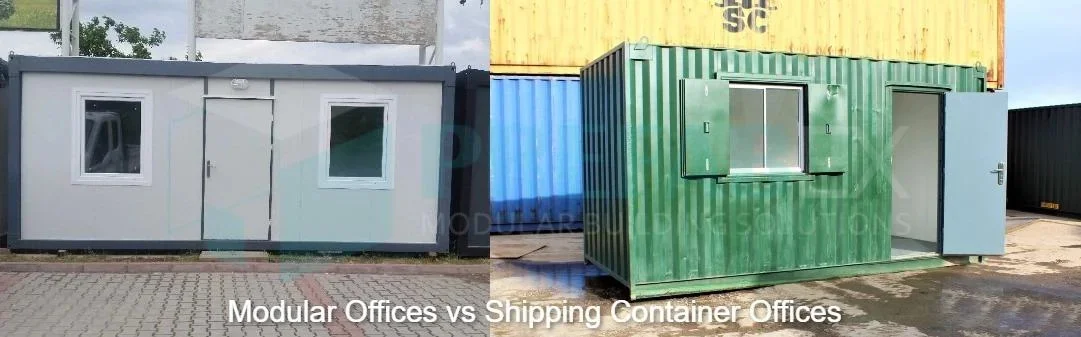
When comparing portacabins in Dubai with modified shipping containers, two options deserve particular attention: lightweight insulated sandwich-panel cabins and heavy-duty Corten steel containers. Although both can provide usable enclosed space, their construction, thermal performance, lifting requirements, and long-term financial value are different.
This guide examines these differences to help contractors, project managers, facility operators, and procurement teams select the right solution for UAE operating conditions.
Understanding Portacabins and Their Applications in Dubai
A portacabin is a prefabricated modular structure manufactured using a supporting frame, wall panels, roofing, flooring, doors, windows, and electrical provisions. Depending on its specification, it can be supplied as a basic enclosed cabin or a fully equipped office or accommodation unit.
Unlike conventional buildings, most of the fabrication and interior preparation can be completed before the unit reaches the project location. This reduces the amount of construction work required on-site.
Businesses commonly use portacabins for:
Construction-site offices and management rooms.
Temporary meeting rooms and administrative facilities.
Security cabins and reception areas.
Staff accommodation and welfare facilities.
Industrial workshops and control rooms.
Temporary classrooms and healthcare facilities.
Project offices for infrastructure and utility developments.
The configuration depends on the intended application. For example, a construction manager may need a furnished office with air conditioning, lighting, electrical sockets, and workstations, while a contractor may require a multi-room accommodation arrangement with additional plumbing and sanitary facilities.
A properly specified prefab accommodation unit can also be configured with bedrooms, washrooms, storage areas, and shared facilities, depending on applicable occupancy and safety requirements.
Structural Differences: Sandwich Panel Portacabins vs Corten Steel Containers
One of the most important decisions when purchasing temporary site infrastructure is selecting the correct structural design.
Although portacabins and modified shipping containers may look similar after installation, their original engineering purposes are different.
A conventional portacabin is generally designed to provide usable indoor space with relatively lightweight construction. A shipping container, on the other hand, is originally engineered for cargo transportation, stacking, and handling through established lifting points.
1. Lightweight insulated sandwich-panel portacabins
These units typically combine a structural steel frame with insulated wall and roof panels. Depending on the manufacturer, the panels may contain polyurethane (PU), polyisocyanurate (PIR), or expanded polystyrene (EPS) insulation.
Their relatively lightweight construction makes them suitable for temporary offices, accommodation, security rooms, and facilities that need frequent relocation.
2. Heavy-duty Corten steel containers
Standard shipping containers commonly use weathering steel, including Corten-type grades, with corrugated steel walls, reinforced corner posts, top and bottom rails, and standardized corner castings.
Their original engineering focuses on cargo protection, stacking loads, and transportation handling. This makes them useful where a project requires a robust storage or modified container-based structure.
Comparing their construction
Structural feature | Sandwich-panel portacabin | Corten steel container |
|---|---|---|
Main structure | Steel support frame | Heavy-duty steel frame |
External walls | Insulated sandwich panels | Corrugated steel |
Roof | Usually insulated panels | Steel roof |
Thermal insulation | Commonly integrated | Usually requires additional insulation |
Structural purpose | Occupied modular space | Cargo transport and stacking |
Interior customization | Generally straightforward | Requires cutting, framing and finishing |
Typical applications | Offices and accommodation | Storage and modified offices |
The distinction is important when planning a long-term site office. A container may offer a stronger original cargo structure, but that does not automatically make it a better occupied building. Adding windows, doors, insulation, partitions, and air-conditioning changes its original configuration.
Similarly, a sandwich-panel cabin should not be assumed to have the same load-bearing capacity as a shipping container.
The actual structural performance depends on the frame design, panel specifications, connections, lifting arrangement, and manufacturer's engineering documentation.
Mobility and Relocation: Which Structure Is Better for Repeated Crane Lifts?
Construction projects in Dubai frequently change location as work progresses. A temporary office may initially be required near the main construction entrance and later need to move closer to another work zone.
For contractors operating across Dubai, Sharjah, Abu Dhabi, and other Emirates, transportation and relocation should be considered before purchasing a cabin.
Moving lightweight portacabins
Lightweight sandwich-panel portacabins can be convenient for relocation because their construction generally involves less structural mass than a comparable heavy steel container.
However, lightweight construction does not mean that a cabin can be lifted from any point.
A properly manufactured portacabin should have designated lifting points or an engineered lifting arrangement. The lifting frame, spreader beam, sling positions, and load distribution must follow the manufacturer's instructions.
Incorrect lifting can cause:
Frame distortion.
Roof damage.
Separation between wall panels and structural members.
Door and window misalignment.
Damage to internal electrical connections.
Floor deformation.
For repeated relocation, buyers should request the cabin's empty weight, lifting-point drawings, and approved lifting instructions.
Moving modified shipping containers
Shipping containers have an advantage when repeated crane handling is part of the operating requirement.
Standard ISO containers are designed around standardized corner fittings, with corner castings used for compatible lifting and handling equipment. These features are part of their original transportation design.
However, an important distinction applies to modified containers.
Cutting large openings into the sidewalls, removing structural sections, adding doors, or changing the roof can affect the original structural performance. A modified container should therefore be inspected to confirm that its corner posts, rails, connections, and lifting arrangement remain suitable for the intended handling.
The original container's lifting capability should never automatically be applied to a heavily modified unit.
Portacabin vs container relocation comparison
Requirement | Portacabin | Shipping container |
|---|---|---|
Repeated crane handling | Depends on engineered lifting points | Standardized corner fittings |
Road transportation | Requires suitable flatbed or trailer | Established container transport arrangements |
Structural weight | Generally lighter | Generally heavier |
Relocation between Emirates | Suitable with proper transport planning | Suitable with proper transport planning |
Post-modification lifting | Requires verification | Requires verification |
Main advantage | Easier lightweight modular deployment | Purpose-designed cargo handling structure |
For repeated crane lifts, an unmodified ISO container with verified corner castings generally has an advantage in standardized handling. For temporary offices and accommodation that need to be moved between project sites, a purpose-designed lifting-frame portacabin may be more convenient because of its lower weight.
Neither option should be lifted without confirming its actual weight, lifting points, centre of gravity, and suitable crane capacity.
Thermal Efficiency: Preparing Portacabins for 50°C UAE Summer Conditions
Thermal performance is one of the biggest considerations when selecting portacabins in Dubai.
During summer, a temporary cabin exposed to direct sunlight can experience substantial heat gain through its roof, walls, windows, and doors. The problem becomes more noticeable when the unit has poor insulation, dark exterior surfaces, inadequate ventilation, or insufficient air-conditioning capacity.
For an occupied office, controlling indoor temperature is important for employee comfort, equipment operation, and maintaining a productive working environment.
Why sandwich panels can offer better thermal performance
Insulated sandwich panels consist of external and internal facing materials separated by an insulating core.
Common insulation options include:
PU (Polyurethane): Provides effective thermal insulation and is widely used in prefabricated building panels.
PIR (Polyisocyanurate): Offers thermal insulation with different fire-performance characteristics depending on the complete tested panel system.
EPS (Expanded Polystyrene): Provides insulation at a generally economical material cost, although performance depends on panel thickness and specification.
For example, Assan Panel publishes polyurethane insulation technical data with a thermal conductivity coefficient of approximately 0.022 W/mK. This illustrates why insulation-core selection matters when specifying a cabin for hot climates.
However, the insulation core alone does not determine the complete cabin's thermal performance. Panel joints, doors, glazing, roof construction, floor insulation, and air leakage also matter.
Why uninsulated steel containers become hotter
A conventional steel shipping container has a metal exterior without the integrated thermal insulation normally found in an insulated portacabin.
Under direct sunlight, the steel envelope absorbs solar energy and transfers heat towards the interior.
For a modified container office, additional work may be required, including:
Internal insulation installation.
Ceiling and wall lining.
Insulated partitions.
Thermal treatment of the roof.
Sealing around doors and windows.
Air-conditioning installation.
Moisture and condensation management.
This additional finishing can improve comfort, but it also increases the overall project cost and reduces some of the original internal space.
Air-conditioning requirements for 50°C exposure
A common mistake is selecting an air conditioner based only on the floor area of a temporary cabin.
A 20-foot container office and a 20-foot insulated portacabin may have similar dimensions, but their cooling requirements can differ considerably because of insulation, solar exposure, glazing, occupancy, and internal equipment.
Dubai's published DEWA Green Building Regulations provide useful historical design reference conditions, including an outdoor dry-bulb temperature of 46°C and an indoor design condition of 24°C with 50% relative humidity. A 50°C exposure scenario should therefore be treated as a demanding stress condition, not automatically as the prescribed HVAC design temperature for every project.
ASHRAE's cooling-load methodology also explains that air-conditioning capacity must account for building materials, outdoor conditions, orientation, solar exposure, windows, occupancy, equipment, and ventilation.
Illustrative cooling capacity comparison
The following figures are preliminary planning examples, not engineered equipment selections. They assume a small, single-room office with normal office occupancy and no unusually high equipment load.
Cabin configuration | Illustrative AC capacity |
|---|---|
Small insulated office, 10–15 m² | 1.5–2 TR |
Insulated office, 18–25 m² | 2–3 TR |
Larger insulated office, 25–35 m² | 3–4 TR |
Modified steel container office, 14–15 m² | 2–3 TR or more |
Modified container with substantial heat gain | Project-specific calculation |
TR means refrigeration ton. These indicative ranges are not substitutes for a cooling-load calculation, and the actual requirement can fall outside them.
For a cabin exposed to direct afternoon sunlight, additional attention should be given to roof insulation, external shading, window orientation, and air leakage.
Practical measures to improve cooling efficiency
1. Install reflective roof finishes
A suitable light-coloured or reflective roof finish can reduce the amount of solar radiation absorbed by the external surface.
2. Improve roof insulation
The roof is particularly important because it receives direct solar exposure for extended periods. Properly specified insulated roofing helps reduce heat transfer into the cabin.
3. Select the correct air-conditioning capacity
The system should be selected after considering the cabin's actual thermal envelope, ventilation, occupancy, and equipment loads.
4. Seal doors and windows
Air leakage can introduce hot outdoor air and increase the cooling load. Proper sealing around openings is therefore essential.
5. Provide external shading
Where site conditions allow, a canopy or shaded installation can reduce direct solar exposure.
6. Maintain air-conditioning equipment
Dirty filters, blocked condensers, poor airflow, and inadequate maintenance can reduce cooling performance during peak summer conditions.
For contractors comparing a conventional container with an insulated modular office, the important consideration is the total cooling requirement over the entire project duration, rather than the purchase price of the air conditioner alone.
Cost Comparison: Initial Purchase, Interior Finishing and Resale Value
The purchase price is only one part of the financial decision. Businesses should evaluate the complete cost of owning, operating, relocating, and eventually selling a temporary structure.
A cheaper container may require considerable modification before it becomes suitable for office use. A prefabricated cabin may have a higher initial price but already include insulation, flooring, electrical provisions, and air-conditioning arrangements.
The best option depends on project duration, required specifications, and expected resale value.
1. Initial purchase cost
A standard insulated portacabin and an empty shipping container are not directly comparable products.
A basic shipping container may have a lower initial purchase price because it is supplied primarily for cargo storage. However, a purpose-built site office cabin may already include several features required for immediate occupation.
The purchase quotation should identify:
Structural frame and external wall materials.
Roof and floor construction.
Insulation material and thickness.
Doors, windows, and ventilation.
Electrical wiring and distribution board.
Air-conditioning provisions.
Internal partitions and finishes.
Delivery and crane offloading.
For businesses requiring ready-to-use site office cabins UAE, comparing the complete specification is more useful than comparing the structure-only purchase price.
2. Interior finishing and modification expenses
A modified container office may require additional construction work before employees can use it comfortably.
Typical modifications include cutting and reinforcing openings, installing insulated wall linings, fitting ceilings, adding windows and doors, installing electrical systems, and providing air conditioning.
A purpose-built portacabin may already include many of these features.
Cost component | Insulated portacabin | Modified container office |
|---|---|---|
Structural construction | Generally included | Existing container structure |
Insulation | Usually integrated | Often additional |
Interior wall lining | Depends on specification | Commonly required |
Ceiling finishing | Depends on specification | May require installation |
Windows and doors | Usually included in office models | Cutting and reinforcement may be required |
Electrical installation | Available as an option or standard | Usually requires modification |
Air conditioning | Available as an option or standard | Requires installation and suitable insulation |
Plumbing | Available in accommodation models | Requires additional modification |
Final finishing | Often less extensive | Can require substantial work |
For a business that needs an operational office quickly, an insulated cabin can reduce the amount of work required after delivery.
A modified container may still be a good investment where heavy-duty construction, storage, or a specific container-based layout is important.
3. Resale and liquidation value after project completion
Temporary structures should also be evaluated as recoverable business assets.
When a construction contract finishes, companies may have several surplus cabins that occupy valuable storage space. Keeping unused structures can create additional handling, maintenance, and yard-storage requirements.
A resale or buyback arrangement can help recover part of the original investment.
Portacabin resale considerations
A well-maintained portacabin can retain commercial value when it has:
A structurally sound steel frame.
Good-quality insulated panels.
Functional electrical installations.
Undamaged flooring and roofing.
Working air-conditioning equipment.
A practical office or accommodation layout.
Available maintenance and refurbishment records.
Container resale considerations
Shipping containers can also have resale demand, particularly when their original structural integrity, doors, corner castings, and weather-resistant condition remain intact.
However, extensively modified containers may appeal to a narrower group of buyers. Unusual internal layouts, non-standard openings, and poor-quality modifications can affect their resale potential.
Comparing the complete financial picture
Financial factor | Portacabin | Modified container |
|---|---|---|
Initial purchase | Depends on insulation and fit-out | Depends on size and container condition |
Modification expenses | Often lower for ready-built offices | Can be higher |
Cooling expenses | Potentially lower with good insulation | Depends on added insulation |
Relocation | Depends on lifting design | Standard handling advantages for unmodified ISO units |
Refurbishment | Panel, frame and interior repairs | Steel, insulation and interior repairs |
Resale market | Office and accommodation buyers | Storage and container buyers |
Liquidation | Depends on condition and demand | Depends on condition and modification level |
There is no reliable universal resale percentage that applies to every unit. Age, condition, structural integrity, demand, and refurbishment costs influence the final valuation.
For businesses planning asset liquidation, it is useful to identify potential buyers before purchasing the units.
Rental Power provides information about buying and selling new, used, and refurbished cabins through its portacabin resale service.
Modified Container Office Dubai: When Is It the Better Option?
A modified shipping container can be a suitable alternative when a business needs a robust structure for storage, industrial applications, or a customized office.
The key is to understand the difference between the original cargo container and the finished office.
A conventional container is designed for transporting goods. Once it is modified for human occupancy, additional engineering and building services may be required.
For example, a container converted into an office may need:
Thermal insulation for walls and ceilings.
Internal plasterboard or other suitable lining.
Additional windows and access doors.
Electrical distribution and lighting.
Split air-conditioning equipment.
Ventilation and moisture control.
Floor covering and interior partitions.
A properly modified container can provide a functional office, but the quality of conversion determines its suitability.
For storage requirements where internal finishing is unnecessary, a standard shipping container may be the more economical choice.
Explore available used storage containers for storage and other project requirements.
Site Office Cabins UAE: Important Features to Check Before Purchasing
Before selecting a cabin, procurement teams should prepare a specification based on the actual site requirements.
A small security cabin does not need the same facilities as an executive office or a staff accommodation building.
Structural specifications
Confirm the supporting frame material, steel thickness, structural connections, floor capacity, and lifting arrangements.
For a relocated cabin, request manufacturer-approved lifting instructions.
Thermal insulation
Ask for the insulation material and thickness used in the walls and roof. Also check the floor, doors, windows, and joints.
For UAE summer conditions, roof insulation and external shading deserve particular attention.
Electrical installation
Check the electrical distribution board, wiring, socket capacity, lighting, earthing, and suitability for the proposed air-conditioning equipment.
Interior layout
The layout should match the expected number of occupants and the intended application.
A management office may require partitions and meeting facilities, while a staff accommodation unit may require bedrooms, washrooms, and additional ventilation.
Fire safety and approvals
Fire safety requirements should be confirmed before purchasing or installing a temporary occupied structure.
For example, Dubai's Ports, Customs and Free Zone Corporation (PCFC) provides specific guidance for temporary portacabin and container use within relevant jurisdictions.
Its published guidance identifies requirements that can include:
Initial approval from the relevant property department.
A site layout showing the proposed cabin location.
Drainage drawings.
Fire-protection arrangements.
Detailed construction drawings and material specifications.
A minimum 30-minute fire rating for construction materials under the stated temporary-use approval requirements.
These requirements relate to the relevant PCFC-controlled locations and should not be assumed to apply identically across every Dubai site.
Dubai Municipality also publishes the Dubai Building Code, which addresses building safety, environmental performance, and other design requirements.
Always confirm the applicable approval process with the authority responsible for the project location.
Prefab Accommodation Unit: Choosing the Right Configuration
Accommodation requirements are different from ordinary office requirements.
A prefab accommodation unit must provide a suitable indoor environment for its intended occupants. It should be designed around the number of people, sleeping arrangements, sanitary facilities, ventilation, cooling, and fire safety.
A suitable accommodation configuration may include:
Sleeping areas: Properly arranged beds, sufficient circulation space, and appropriate privacy.
Sanitary facilities: Toilets, showers, washbasins, plumbing, and drainage.
Air conditioning: Cooling equipment selected according to room dimensions, insulation, occupancy, and heat gain.
Electrical facilities: Safe lighting, sockets, distribution boards, and suitable electrical capacity.
Fire safety: Appropriate fire-rated construction, emergency access, detection, and extinguishing provisions as required by the relevant authority.
For longer projects, businesses should also consider the maintenance requirements of the accommodation facilities.
Why Buy or Source Portacabins Through Rental Power?
Selecting a suitable supplier is an important part of purchasing temporary infrastructure.
Rental Power provides portacabin-related solutions for projects requiring temporary offices, security cabins, accommodation facilities, and other modular structures.
Businesses can explore different configurations depending on their project requirements, available space, and budget.
Whether you require a basic office cabin or a more extensively fitted modular unit, the specification should be agreed before delivery.
Before requesting a quotation, it is helpful to provide the required dimensions, intended use, number of occupants, installation location, insulation requirements, air-conditioning needs, and expected project duration.
This information helps establish a more accurate specification and avoids unnecessary modifications after delivery.
Which Is Better for Your Dubai Project: Portacabin or Modified Container?
There is no single solution for every business. The right choice depends on whether the priority is comfortable occupied space, heavy-duty transportation, storage, or long-term asset recovery.
Project requirement | Recommended option |
|---|---|
Temporary construction office | Insulated portacabin |
Executive site office | Fully fitted portacabin |
Staff accommodation | Purpose-built accommodation cabin |
Heavy-duty general storage | Shipping container |
Repeated standardized crane handling | Suitable ISO shipping container |
Lightweight modular office relocation | Engineered lifting-frame portacabin |
Customized container-based workspace | Modified shipping container |
Lower interior modification requirements | Ready-fitted portacabin |
For most businesses requiring comfortable temporary office space in Dubai, an insulated sandwich-panel portacabin is a practical starting point.
For businesses prioritizing cargo handling, robust storage, or container-based applications, a shipping container may offer greater suitability.
The final decision should account for the complete installation cost, cooling performance, relocation requirements, and potential resale value.
Frequently Asked Questions
1. What are portacabins used for in Dubai?
Portacabins are used for construction-site offices, security cabins, temporary meeting rooms, staff accommodation, industrial facilities, and other applications requiring prefabricated indoor space.
2. What is the difference between a portacabin and a shipping container?
A portacabin is generally constructed using a steel support frame and insulated sandwich panels. A shipping container typically uses a heavy-duty steel structure with corrugated metal walls and standardized corner fittings.
Portacabins are commonly designed for occupied spaces, while shipping containers are originally designed for cargo transportation and storage.
3. Are insulated portacabins suitable for Dubai summers?
Yes. Properly specified insulated portacabins can provide comfortable indoor conditions when combined with suitable air conditioning, roof insulation, shading, and effective sealing.
The actual cooling requirement depends on the cabin's size, orientation, occupancy, insulation, and equipment.
4. Can shipping containers be converted into offices?
Yes. Shipping containers can be modified with insulation, internal lining, doors, windows, electrical installations, flooring, and air conditioning.
However, structural modifications must be assessed to ensure that the container remains suitable for its intended use and lifting requirements.
5. Which is easier to relocate between Dubai and Abu Dhabi?
Both options can be transported between Emirates using suitable vehicles and lifting equipment.
A lightweight portacabin can offer advantages in handling weight, while a standard ISO container benefits from established transportation and standardized corner-fitting arrangements.
The final choice depends on the unit's dimensions, weight, modifications, and lifting design.
6. Is a modified container cheaper than a portacabin?
A basic empty container may have a lower initial purchase price. However, converting it into a comfortable office can require insulation, electrical installation, interior finishing, windows, doors, and air conditioning.
A ready-fitted portacabin may therefore offer better overall value when the intended use is office accommodation.
7. Can businesses sell portacabins after project completion?
Yes. Businesses can seek resale or buyback options for surplus portacabins after project completion. The final valuation depends on structural condition, age, insulation, equipment, and market demand.
8. What should I check before buying a used portacabin?
Inspect the structural frame, lifting points, roof, insulation, flooring, electrical system, air conditioning, doors, windows, and previous refurbishment work.
Also confirm transportation, installation, and applicable site approvals before purchasing.
Conclusion
Choosing between portacabins and modified shipping containers requires more than comparing their external appearance or initial purchase prices.
Insulated sandwich-panel cabins are generally more suitable for businesses prioritizing ready-to-use office space, thermal efficiency, and comfortable accommodation. Corten steel shipping containers offer advantages in standardized cargo handling, stacking, and storage applications, although converting them into occupied offices requires additional consideration.
For Dubai
Portacabins in Dubai: Complete Guide to Structure, Mobility, Insulation and Cost Comparison
Dubai's construction, infrastructure, oil and gas, logistics, and industrial sectors require temporary buildings that can be installed quickly and relocated when project requirements change. From construction-site offices to staff accommodation and temporary management facilities, prefabricated cabins offer a practical alternative to conventional construction.
However, choosing the right temporary structure is not simply about comparing dimensions or purchase prices. Businesses must consider structural strength, insulation, transportation requirements, air-conditioning performance, interior finishing, and resale value after project completion.
When comparing portacabins in Dubai with modified shipping containers, two options deserve particular attention: lightweight insulated sandwich-panel cabins and heavy-duty Corten steel containers. Although both can provide usable enclosed space, their construction, thermal performance, lifting requirements, and long-term financial value are different.
This guide examines these differences to help contractors, project managers, facility operators, and procurement teams select the right solution for UAE operating conditions.
Understanding Portacabins and Their Applications in Dubai
A portacabin is a prefabricated modular structure manufactured using a supporting frame, wall panels, roofing, flooring, doors, windows, and electrical provisions. Depending on its specification, it can be supplied as a basic enclosed cabin or a fully equipped office or accommodation unit.
Unlike conventional buildings, most of the fabrication and interior preparation can be completed before the unit reaches the project location. This reduces the amount of construction work required on-site.
Businesses commonly use portacabins for:
Construction-site offices and management rooms.
Temporary meeting rooms and administrative facilities.
Security cabins and reception areas.
Staff accommodation and welfare facilities.
Industrial workshops and control rooms.
Temporary classrooms and healthcare facilities.
Project offices for infrastructure and utility developments.
The configuration depends on the intended application. For example, a construction manager may need a furnished office with air conditioning, lighting, electrical sockets, and workstations, while a contractor may require a multi-room accommodation arrangement with additional plumbing and sanitary facilities.
A properly specified prefab accommodation unit can also be configured with bedrooms, washrooms, storage areas, and shared facilities, depending on applicable occupancy and safety requirements.
Structural Differences: Sandwich Panel Portacabins vs Corten Steel Containers
One of the most important decisions when purchasing temporary site infrastructure is selecting the correct structural design.
Although portacabins and modified shipping containers may look similar after installation, their original engineering purposes are different.
A conventional portacabin is generally designed to provide usable indoor space with relatively lightweight construction. A shipping container, on the other hand, is originally engineered for cargo transportation, stacking, and handling through established lifting points.
1. Lightweight insulated sandwich-panel portacabins
These units typically combine a structural steel frame with insulated wall and roof panels. Depending on the manufacturer, the panels may contain polyurethane (PU), polyisocyanurate (PIR), or expanded polystyrene (EPS) insulation.
Their relatively lightweight construction makes them suitable for temporary offices, accommodation, security rooms, and facilities that need frequent relocation.
2. Heavy-duty Corten steel containers
Standard shipping containers commonly use weathering steel, including Corten-type grades, with corrugated steel walls, reinforced corner posts, top and bottom rails, and standardized corner castings.
Their original engineering focuses on cargo protection, stacking loads, and transportation handling. This makes them useful where a project requires a robust storage or modified container-based structure.
Comparing their construction
Structural feature | Sandwich-panel portacabin | Corten steel container |
|---|---|---|
Main structure | Steel support frame | Heavy-duty steel frame |
External walls | Insulated sandwich panels | Corrugated steel |
Roof | Usually insulated panels | Steel roof |
Thermal insulation | Commonly integrated | Usually requires additional insulation |
Structural purpose | Occupied modular space | Cargo transport and stacking |
Interior customization | Generally straightforward | Requires cutting, framing and finishing |
Typical applications | Offices and accommodation | Storage and modified offices |
The distinction is important when planning a long-term site office. A container may offer a stronger original cargo structure, but that does not automatically make it a better occupied building. Adding windows, doors, insulation, partitions, and air-conditioning changes its original configuration.
Similarly, a sandwich-panel cabin should not be assumed to have the same load-bearing capacity as a shipping container.
The actual structural performance depends on the frame design, panel specifications, connections, lifting arrangement, and manufacturer's engineering documentation.
Research reference: ISO standard container specifications – Tanax Containers and Sandwich panel technical information – Assan Panel.
Mobility and Relocation: Which Structure Is Better for Repeated Crane Lifts?
Construction projects in Dubai frequently change location as work progresses. A temporary office may initially be required near the main construction entrance and later need to move closer to another work zone.
For contractors operating across Dubai, Sharjah, Abu Dhabi, and other Emirates, transportation and relocation should be considered before purchasing a cabin.
Moving lightweight portacabins
Lightweight sandwich-panel portacabins can be convenient for relocation because their construction generally involves less structural mass than a comparable heavy steel container.
However, lightweight construction does not mean that a cabin can be lifted from any point.
A properly manufactured portacabin should have designated lifting points or an engineered lifting arrangement. The lifting frame, spreader beam, sling positions, and load distribution must follow the manufacturer's instructions.
Incorrect lifting can cause:
Frame distortion.
Roof damage.
Separation between wall panels and structural members.
Door and window misalignment.
Damage to internal electrical connections.
Floor deformation.
For repeated relocation, buyers should request the cabin's empty weight, lifting-point drawings, and approved lifting instructions.
Moving modified shipping containers
Shipping containers have an advantage when repeated crane handling is part of the operating requirement.
Standard ISO containers are designed around standardized corner fittings, with corner castings used for compatible lifting and handling equipment. These features are part of their original transportation design.
However, an important distinction applies to modified containers.
Cutting large openings into the sidewalls, removing structural sections, adding doors, or changing the roof can affect the original structural performance. A modified container should therefore be inspected to confirm that its corner posts, rails, connections, and lifting arrangement remain suitable for the intended handling.
The original container's lifting capability should never automatically be applied to a heavily modified unit.
Portacabin vs container relocation comparison
Requirement | Portacabin | Shipping container |
|---|---|---|
Repeated crane handling | Depends on engineered lifting points | Standardized corner fittings |
Road transportation | Requires suitable flatbed or trailer | Established container transport arrangements |
Structural weight | Generally lighter | Generally heavier |
Relocation between Emirates | Suitable with proper transport planning | Suitable with proper transport planning |
Post-modification lifting | Requires verification | Requires verification |
Main advantage | Easier lightweight modular deployment | Purpose-designed cargo handling structure |
For repeated crane lifts, an unmodified ISO container with verified corner castings generally has an advantage in standardized handling. For temporary offices and accommodation that need to be moved between project sites, a purpose-designed lifting-frame portacabin may be more convenient because of its lower weight.
Neither option should be lifted without confirming its actual weight, lifting points, centre of gravity, and suitable crane capacity.
Technical reference: ISO container dimensions and corner castings and Ruukki container unloading instructions.
Thermal Efficiency: Preparing Portacabins for 50°C UAE Summer Conditions
Thermal performance is one of the biggest considerations when selecting portacabins in Dubai.
During summer, a temporary cabin exposed to direct sunlight can experience substantial heat gain through its roof, walls, windows, and doors. The problem becomes more noticeable when the unit has poor insulation, dark exterior surfaces, inadequate ventilation, or insufficient air-conditioning capacity.
For an occupied office, controlling indoor temperature is important for employee comfort, equipment operation, and maintaining a productive working environment.
Why sandwich panels can offer better thermal performance
Insulated sandwich panels consist of external and internal facing materials separated by an insulating core.
Common insulation options include:
PU (Polyurethane): Provides effective thermal insulation and is widely used in prefabricated building panels.
PIR (Polyisocyanurate): Offers thermal insulation with different fire-performance characteristics depending on the complete tested panel system.
EPS (Expanded Polystyrene): Provides insulation at a generally economical material cost, although performance depends on panel thickness and specification.
For example, Assan Panel publishes polyurethane insulation technical data with a thermal conductivity coefficient of approximately 0.022 W/mK. This illustrates why insulation-core selection matters when specifying a cabin for hot climates.
However, the insulation core alone does not determine the complete cabin's thermal performance. Panel joints, doors, glazing, roof construction, floor insulation, and air leakage also matter.
Why uninsulated steel containers become hotter
A conventional steel shipping container has a metal exterior without the integrated thermal insulation normally found in an insulated portacabin.
Under direct sunlight, the steel envelope absorbs solar energy and transfers heat towards the interior.
For a modified container office, additional work may be required, including:
Internal insulation installation.
Ceiling and wall lining.
Insulated partitions.
Thermal treatment of the roof.
Sealing around doors and windows.
Air-conditioning installation.
Moisture and condensation management.
This additional finishing can improve comfort, but it also increases the overall project cost and reduces some of the original internal space.
Air-conditioning requirements for 50°C exposure
A common mistake is selecting an air conditioner based only on the floor area of a temporary cabin.
A 20-foot container office and a 20-foot insulated portacabin may have similar dimensions, but their cooling requirements can differ considerably because of insulation, solar exposure, glazing, occupancy, and internal equipment.
Dubai's published DEWA Green Building Regulations provide useful historical design reference conditions, including an outdoor dry-bulb temperature of 46°C and an indoor design condition of 24°C with 50% relative humidity. A 50°C exposure scenario should therefore be treated as a demanding stress condition, not automatically as the prescribed HVAC design temperature for every project.
ASHRAE's cooling-load methodology also explains that air-conditioning capacity must account for building materials, outdoor conditions, orientation, solar exposure, windows, occupancy, equipment, and ventilation.
Illustrative cooling capacity comparison
The following figures are preliminary planning examples, not engineered equipment selections. They assume a small, single-room office with normal office occupancy and no unusually high equipment load.
Cabin configuration | Illustrative AC capacity |
|---|---|
Small insulated office, 10–15 m² | 1.5–2 TR |
Insulated office, 18–25 m² | 2–3 TR |
Larger insulated office, 25–35 m² | 3–4 TR |
Modified steel container office, 14–15 m² | 2–3 TR or more |
Modified container with substantial heat gain | Project-specific calculation |
TR means refrigeration ton. These indicative ranges are not substitutes for a cooling-load calculation, and the actual requirement can fall outside them.
For a cabin exposed to direct afternoon sunlight, additional attention should be given to roof insulation, external shading, window orientation, and air leakage.
Practical measures to improve cooling efficiency
1. Install reflective roof finishes
A suitable light-coloured or reflective roof finish can reduce the amount of solar radiation absorbed by the external surface.
2. Improve roof insulation
The roof is particularly important because it receives direct solar exposure for extended periods. Properly specified insulated roofing helps reduce heat transfer into the cabin.
3. Select the correct air-conditioning capacity
The system should be selected after considering the cabin's actual thermal envelope, ventilation, occupancy, and equipment loads.
4. Seal doors and windows
Air leakage can introduce hot outdoor air and increase the cooling load. Proper sealing around openings is therefore essential.
5. Provide external shading
Where site conditions allow, a canopy or shaded installation can reduce direct solar exposure.
6. Maintain air-conditioning equipment
Dirty filters, blocked condensers, poor airflow, and inadequate maintenance can reduce cooling performance during peak summer conditions.
For contractors comparing a conventional container with an insulated modular office, the important consideration is the total cooling requirement over the entire project duration, rather than the purchase price of the air conditioner alone.
Cost Comparison: Initial Purchase, Interior Finishing and Resale Value
The purchase price is only one part of the financial decision. Businesses should evaluate the complete cost of owning, operating, relocating, and eventually selling a temporary structure.
A cheaper container may require considerable modification before it becomes suitable for office use. A prefabricated cabin may have a higher initial price but already include insulation, flooring, electrical provisions, and air-conditioning arrangements.
The best option depends on project duration, required specifications, and expected resale value.
1. Initial purchase cost
A standard insulated portacabin and an empty shipping container are not directly comparable products.
A basic shipping container may have a lower initial purchase price because it is supplied primarily for cargo storage. However, a purpose-built site office cabin may already include several features required for immediate occupation.
The purchase quotation should identify:
Structural frame and external wall materials.
Roof and floor construction.
Insulation material and thickness.
Doors, windows, and ventilation.
Electrical wiring and distribution board.
Air-conditioning provisions.
Internal partitions and finishes.
Delivery and crane offloading.
For businesses requiring ready-to-use site office cabins UAE, comparing the complete specification is more useful than comparing the structure-only purchase price.
2. Interior finishing and modification expenses
A modified container office may require additional construction work before employees can use it comfortably.
Typical modifications include cutting and reinforcing openings, installing insulated wall linings, fitting ceilings, adding windows and doors, installing electrical systems, and providing air conditioning.
A purpose-built portacabin may already include many of these features.
Cost component | Insulated portacabin | Modified container office |
|---|---|---|
Structural construction | Generally included | Existing container structure |
Insulation | Usually integrated | Often additional |
Interior wall lining | Depends on specification | Commonly required |
Ceiling finishing | Depends on specification | May require installation |
Windows and doors | Usually included in office models | Cutting and reinforcement may be required |
Electrical installation | Available as an option or standard | Usually requires modification |
Air conditioning | Available as an option or standard | Requires installation and suitable insulation |
Plumbing | Available in accommodation models | Requires additional modification |
Final finishing | Often less extensive | Can require substantial work |
For a business that needs an operational office quickly, an insulated cabin can reduce the amount of work required after delivery.
A modified container may still be a good investment where heavy-duty construction, storage, or a specific container-based layout is important.
3. Resale and liquidation value after project completion
Temporary structures should also be evaluated as recoverable business assets.
When a construction contract finishes, companies may have several surplus cabins that occupy valuable storage space. Keeping unused structures can create additional handling, maintenance, and yard-storage requirements.
A resale or buyback arrangement can help recover part of the original investment.
Portacabin resale considerations
A well-maintained portacabin can retain commercial value when it has:
A structurally sound steel frame.
Good-quality insulated panels.
Functional electrical installations.
Undamaged flooring and roofing.
Working air-conditioning equipment.
A practical office or accommodation layout.
Available maintenance and refurbishment records.
Container resale considerations
Shipping containers can also have resale demand, particularly when their original structural integrity, doors, corner castings, and weather-resistant condition remain intact.
However, extensively modified containers may appeal to a narrower group of buyers. Unusual internal layouts, non-standard openings, and poor-quality modifications can affect their resale potential.
Comparing the complete financial picture
Financial factor | Portacabin | Modified container |
|---|---|---|
Initial purchase | Depends on insulation and fit-out | Depends on size and container condition |
Modification expenses | Often lower for ready-built offices | Can be higher |
Cooling expenses | Potentially lower with good insulation | Depends on added insulation |
Relocation | Depends on lifting design | Standard handling advantages for unmodified ISO units |
Refurbishment | Panel, frame and interior repairs | Steel, insulation and interior repairs |
Resale market | Office and accommodation buyers | Storage and container buyers |
Liquidation | Depends on condition and demand | Depends on condition and modification level |
There is no reliable universal resale percentage that applies to every unit. Age, condition, structural integrity, demand, and refurbishment costs influence the final valuation.
For businesses planning asset liquidation, it is useful to identify potential buyers before purchasing the units.
Rental Power provides information about buying and selling new, used, and refurbished cabins through its portacabin resale service.
Modified Container Office Dubai: When Is It the Better Option?
A modified shipping container can be a suitable alternative when a business needs a robust structure for storage, industrial applications, or a customized office.
The key is to understand the difference between the original cargo container and the finished office.
A conventional container is designed for transporting goods. Once it is modified for human occupancy, additional engineering and building services may be required.
For example, a container converted into an office may need:
Thermal insulation for walls and ceilings.
Internal plasterboard or other suitable lining.
Additional windows and access doors.
Electrical distribution and lighting.
Split air-conditioning equipment.
Ventilation and moisture control.
Floor covering and interior partitions.
A properly modified container can provide a functional office, but the quality of conversion determines its suitability.
For storage requirements where internal finishing is unnecessary, a standard shipping container may be the more economical choice.
Explore available used storage containers for storage and other project requirements.
Site Office Cabins UAE: Important Features to Check Before Purchasing
Before selecting a cabin, procurement teams should prepare a specification based on the actual site requirements.
A small security cabin does not need the same facilities as an executive office or a staff accommodation building.
Structural specifications
Confirm the supporting frame material, steel thickness, structural connections, floor capacity, and lifting arrangements.
For a relocated cabin, request manufacturer-approved lifting instructions.
Thermal insulation
Ask for the insulation material and thickness used in the walls and roof. Also check the floor, doors, windows, and joints.
For UAE summer conditions, roof insulation and external shading deserve particular attention.
Electrical installation
Check the electrical distribution board, wiring, socket capacity, lighting, earthing, and suitability for the proposed air-conditioning equipment.
Interior layout
The layout should match the expected number of occupants and the intended application.
A management office may require partitions and meeting facilities, while a staff accommodation unit may require bedrooms, washrooms, and additional ventilation.
Fire safety and approvals
Fire safety requirements should be confirmed before purchasing or installing a temporary occupied structure.
For example, Dubai's Ports, Customs and Free Zone Corporation (PCFC) provides specific guidance for temporary portacabin and container use within relevant jurisdictions.
Its published guidance identifies requirements that can include:
Initial approval from the relevant property department.
A site layout showing the proposed cabin location.
Drainage drawings.
Fire-protection arrangements.
Detailed construction drawings and material specifications.
A minimum 30-minute fire rating for construction materials under the stated temporary-use approval requirements.
These requirements relate to the relevant PCFC-controlled locations and should not be assumed to apply identically across every Dubai site.
Dubai Municipality also publishes the Dubai Building Code, which addresses building safety, environmental performance, and other design requirements.
Always confirm the applicable approval process with the authority responsible for the project location.
Prefab Accommodation Unit: Choosing the Right Configuration
Accommodation requirements are different from ordinary office requirements.
A prefab accommodation unit must provide a suitable indoor environment for its intended occupants. It should be designed around the number of people, sleeping arrangements, sanitary facilities, ventilation, cooling, and fire safety.
A suitable accommodation configuration may include:
Sleeping areas: Properly arranged beds, sufficient circulation space, and appropriate privacy.
Sanitary facilities: Toilets, showers, washbasins, plumbing, and drainage.
Air conditioning: Cooling equipment selected according to room dimensions, insulation, occupancy, and heat gain.
Electrical facilities: Safe lighting, sockets, distribution boards, and suitable electrical capacity.
Fire safety: Appropriate fire-rated construction, emergency access, detection, and extinguishing provisions as required by the relevant authority.
For longer projects, businesses should also consider the maintenance requirements of the accommodation facilities.
Why Buy or Source Portacabins Through Rental Power?
Selecting a suitable supplier is an important part of purchasing temporary infrastructure.
Rental Power provides portacabin-related solutions for projects requiring temporary offices, security cabins, accommodation facilities, and other modular structures.
Businesses can explore different configurations depending on their project requirements, available space, and budget.
Whether you require a basic office cabin or a more extensively fitted modular unit, the specification should be agreed before delivery.
Before requesting a quotation, it is helpful to provide the required dimensions, intended use, number of occupants, installation location, insulation requirements, air-conditioning needs, and expected project duration.
This information helps establish a more accurate specification and avoids unnecessary modifications after delivery.
Which Is Better for Your Dubai Project: Portacabin or Modified Container?
There is no single solution for every business. The right choice depends on whether the priority is comfortable occupied space, heavy-duty transportation, storage, or long-term asset recovery.
Project requirement | Recommended option |
|---|---|
Temporary construction office | Insulated portacabin |
Executive site office | Fully fitted portacabin |
Staff accommodation | Purpose-built accommodation cabin |
Heavy-duty general storage | Shipping container |
Repeated standardized crane handling | Suitable ISO shipping container |
Lightweight modular office relocation | Engineered lifting-frame portacabin |
Customized container-based workspace | Modified shipping container |
Lower interior modification requirements | Ready-fitted portacabin |
For most businesses requiring comfortable temporary office space in Dubai, an insulated sandwich-panel portacabin is a practical starting point.
For businesses prioritizing cargo handling, robust storage, or container-based applications, a shipping container may offer greater suitability.
The final decision should account for the complete installation cost, cooling performance, relocation requirements, and potential resale value.
Frequently Asked Questions
1. What are portacabins used for in Dubai?
Portacabins are used for construction-site offices, security cabins, temporary meeting rooms, staff accommodation, industrial facilities, and other applications requiring prefabricated indoor space.
2. What is the difference between a portacabin and a shipping container?
A portacabin is generally constructed using a steel support frame and insulated sandwich panels. A shipping container typically uses a heavy-duty steel structure with corrugated metal walls and standardized corner fittings.
Portacabins are commonly designed for occupied spaces, while shipping containers are originally designed for cargo transportation and storage.
3. Are insulated portacabins suitable for Dubai summers?
Yes. Properly specified insulated portacabins can provide comfortable indoor conditions when combined with suitable air conditioning, roof insulation, shading, and effective sealing.
The actual cooling requirement depends on the cabin's size, orientation, occupancy, insulation, and equipment.
4. Can shipping containers be converted into offices?
Yes. Shipping containers can be modified with insulation, internal lining, doors, windows, electrical installations, flooring, and air conditioning.
However, structural modifications must be assessed to ensure that the container remains suitable for its intended use and lifting requirements.
5. Which is easier to relocate between Dubai and Abu Dhabi?
Both options can be transported between Emirates using suitable vehicles and lifting equipment.
A lightweight portacabin can offer advantages in handling weight, while a standard ISO container benefits from established transportation and standardized corner-fitting arrangements.
The final choice depends on the unit's dimensions, weight, modifications, and lifting design.
6. Is a modified container cheaper than a portacabin?
A basic empty container may have a lower initial purchase price. However, converting it into a comfortable office can require insulation, electrical installation, interior finishing, windows, doors, and air conditioning.
A ready-fitted portacabin may therefore offer better overall value when the intended use is office accommodation.
7. Can businesses sell portacabins after project completion?
Yes. Businesses can seek resale or buyback options for surplus portacabins after project completion. The final valuation depends on structural condition, age, insulation, equipment, and market demand.
8. What should I check before buying a used portacabin?
Inspect the structural frame, lifting points, roof, insulation, flooring, electrical system, air conditioning, doors, windows, and previous refurbishment work.
Also confirm transportation, installation, and applicable site approvals before purchasing.
Conclusion
Choosing between portacabins and modified shipping containers requires more than comparing their external appearance or initial purchase prices.
Insulated sandwich-panel cabins are generally more suitable for businesses prioritizing ready-to-use office space, thermal efficiency, and comfortable accommodation. Corten steel shipping containers offer advantages in standardized cargo handling, stacking, and storage applications, although converting them into occupied offices requires additional consideration.
For Dubai projects exposed to intense summer temperatures, thermal insulation, correctly calculated air-conditioning capacity, and appropriate structural specifications should remain key purchasing considerations.
Businesses should also consider relocation costs and resale opportunities before committing to a purchase.
By comparing the complete requirements, companies can select portacabins in Dubai that support their project operations while providing better long-term value.projects exposed to intense summer temperatures, thermal insulation, correctly calculated air-conditioning capacity, and appropriate structural specifications should remain key purchasing considerations.
Businesses should also consider relocation costs and resale opportunities before committing to a purchase.
By comparing the complete requirements, companies can select portacabins in Dubai that support their project operations while providing better long-term value.